There is something captivating about Lyra.
A performer climbs into a suspended metal hoop and suddenly the apparatus becomes a stage in the air. A simple circle transforms into beautiful poses, flowing transitions, spins, and dramatic movement.
From the audience, it can look effortless.
It isn’t.
Lyra—also known as aerial hoop—is a discipline that combines artistry and athleticism in a way few other performing arts can.
The Beauty of Lyra
Lyra is beautiful to perform because it allows artists to create shapes and movement in three dimensions.
The hoop can become part of the choreography, with performers moving inside it, around it, above it, and underneath it.
A carefully planned routine can be graceful and fluid. Another might be powerful and dynamic. Music, movement, costume, expression, and choreography can all come together to tell a story.
That artistic side is what audiences often notice first.
But there’s another side to Lyra that isn’t always visible.
What the Audience Doesn’t See
Behind every beautiful Lyra performance is training.
A performer has to develop the physical ability to control their body while suspended in the air. That means working on strength, flexibility, balance, coordination, grip, body awareness, and movement control.
And progress doesn’t happen overnight.
A new skill may require repeated attempts. A transition that looks simple from the audience may take weeks or months of practice.
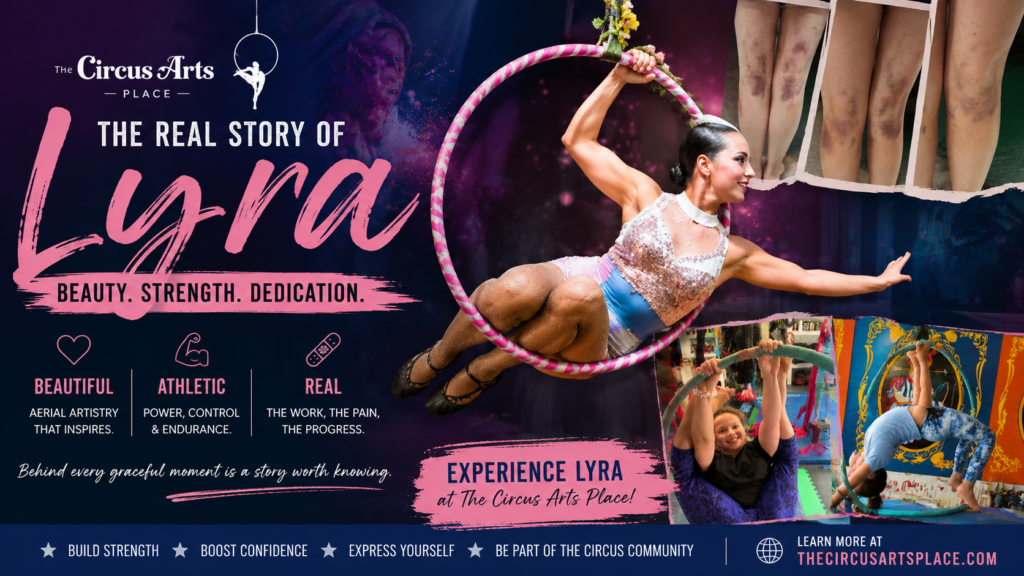
There can be sore muscles.
There can be bruises.
There can be frustration when a skill doesn’t work the way you expected.
And there are plenty of moments when you have to climb back into the hoop and try again.
That’s part of Lyra, too.
There Is a Price for Becoming Great
Lyra can be beautiful to perform and fun for recreation, but serious training can be physically demanding.
The strength and control that make a performer look effortless are earned through consistent practice and conditioning.
If you want to become excellent at the discipline, there is a price to pay.
That price isn’t about suffering for the sake of suffering. It’s about understanding that skill takes work.
You practice the fundamentals.
You strengthen your body.
You learn proper technique.
You repeat movements.
You make adjustments.
You rest and recover.
Then you come back and try again.
Eventually, something that once felt impossible begins to feel natural.
Lyra Is Both Art and Athleticism
One of the most fascinating things about aerial hoop is that it sits between athletics and performance.
A performer needs physical strength to hold a position.
But strength alone isn’t enough.
They also need timing.
They need coordination.
They need awareness of where their body is in space.
They need to understand movement and choreography.
And they need the creativity to turn those technical abilities into a performance.
That’s where the artistry comes in.
The athlete builds the skill. The artist turns that skill into expression.
And Yes—It Can Be Fun!
For all the hard work involved, Lyra can also be incredibly fun.
There’s a unique feeling that comes from leaving the ground and discovering that you can control your movement in the air.
A student might begin with a simple pose.
Then comes a new transition.
Then a spin.
Then another skill.
And eventually, those individual skills can become a sequence or performance.
That sense of accomplishment can be incredibly rewarding.
Lyra doesn’t have to be about becoming a professional performer. It can also be a way to explore movement, challenge yourself, express creativity, or simply try something new.
Everyone Starts Somewhere
Nobody begins as an expert.
Every experienced aerial performer was once a beginner who had to learn the basics.
The first attempt might feel awkward.
The first climb might feel intimidating.
The first pose might not look anything like the picture in your head.
That’s okay.
Circus arts teach an important lesson: progress doesn’t require perfection.
It requires curiosity, patience, practice, and a willingness to keep learning.
Experience Lyra at The Circus Arts Place
At The Circus Arts Place, students and performers have the opportunity to explore the world of circus arts, including aerial disciplines such as Lyra.
Whether you’re interested in aerial arts as a creative outlet, recreational activity, physical challenge, or performing discipline, there is always something new to discover.
Lyra can be beautiful.
It can be challenging.
It can be uncomfortable.
And it can be incredibly rewarding.
Most importantly, it gives you the opportunity to discover what you can do when you step outside the ordinary and get a little closer to the sky.
Come experience Lyra for yourself at The Circus Arts Place.